

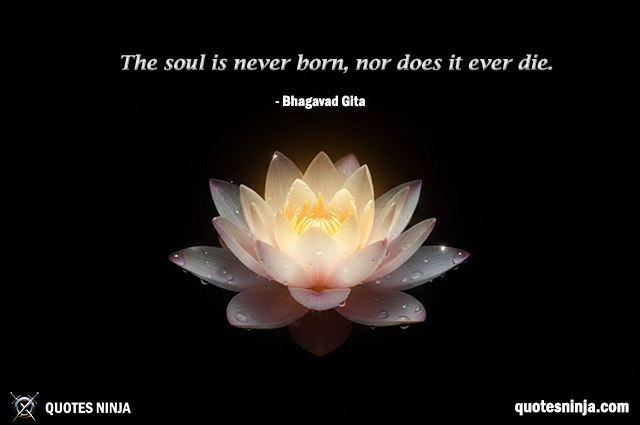
Deeper Meaning of Spiritual Quote
Spiritual Quote: “The soul is never born, nor does it ever die.”
This quote from the Bhagavad Gita verse 2.20 expresses a profound spiritual truth:
You are more than your physical body.
1. The soul is eternal
The body changes—childhood, youth, old age—but the soul remains the same.
It doesn’t come into existence at birth, nor does it disappear at death.
Just like: A person changing clothes (the body) while the wearer (the soul) remains unchanged.
2. Death is only a transition
According to the Gita, death is not an end—
It is simply a shift from one physical form to another, the way one moves from one room to another.
So, what we call “death” is:
- A transformation
- A passage
- A continuation of the soul’s journey
3. True identity is spiritual, not physical
The quote teaches that your real self is not your body, name, or roles.
Your true identity is the Atman—pure consciousness, untouched by time.
This gives inner strength because:
- Nothing can destroy your essence
- No external situation can diminish who you truly are
4. It removes the fear of death
If the soul never dies, then death is not something to fear.
This understanding brings:
- Peace
- Courage
- Freedom from anxiety
5. It encourages spiritual living
Knowing the soul is eternal makes life more purposeful.
You start focusing on:
- Inner growth
- Good actions
- Compassion
- Knowledge
- Detachment from temporary worries
In simple words:
You are an eternal being having a temporary human experience.
A story inspired by Spiritual Quote “The soul is never born, nor does it ever die.”
Spiritual Story: “The River Beyond the Hills“
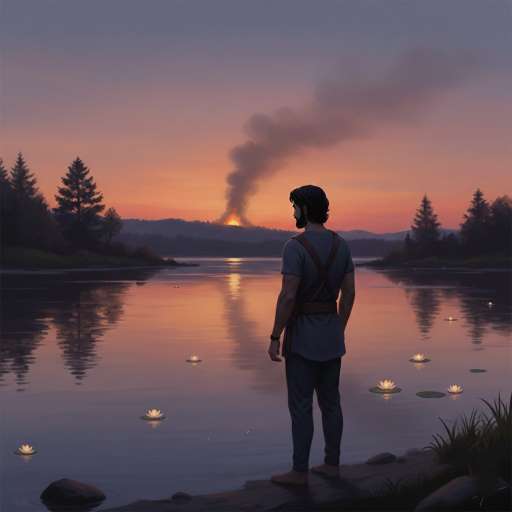
Arjun at the Riverbank:
Arjun stood at the edge of the old riverbank, staring at the water as it moved with quiet determination. The river had always soothed him, but today its murmuring waves only deepened his confusion. His grandfather’s funeral pyre still smoldered on the hill behind him, sending thin wisps of smoke into the fading sky.
He clenched his fists. “Why does it hurt so much? Why does everything have to end?”
The wind carried no answer. Only the river spoke—soft, unbroken, eternal.
As darkness approached, Arjun began walking back toward the village. Halfway up the path, he heard a gentle, familiar voice.
“Still searching for answers, my boy?”
Arjun turned and saw Sage Devanta, the wandering monk whom the villagers respected but rarely understood. His saffron robes fluttered like flames in the evening light.
Arjun’s voice cracked. “Grandfather is gone… I don’t know how to handle this. I feel like a part of me died with him.”
Devanta stepped closer. “Come. Walk with me.”

Sage Devanta by the River:
They walked back toward the river, and the sage sat on a large stone. Arjun followed, though his heart felt heavier with every step. The sage looked at the flowing water with a calm smile.
“You think death has taken something from you,” Devanta began, “but death cannot touch what is real.”
Arjun frowned. “What does that even mean?”
The sage closed his eyes for a moment. Then he recited softly, his voice blending with the river’s whisper:
“Na jāyate mriyate vā kadācin…
The soul is never born, nor does it ever die.”
A gentle silence followed, as if the universe paused to let the words settle.
Arjun stared at him. “But he’s gone. I saw it. Everyone saw it.”
Devanta dipped his fingers into the water and let droplets fall. “Look at the river. The drops that fall from my hand return to it. They appear separate, but in truth, they never leave their source. Your grandfather’s body was a drop. His soul is the river.”
Arjun looked at the water, trying to absorb the idea. “But I miss him.”
“That is natural,” Devanta said. “Attachment makes us human. But understanding the eternal frees us from despair. Your grandfather did not ‘end.’ He simply changed forms.”
Arjun shook his head. “I hear your words, but I don’t feel them.”
Devanta stood. “Then let me show you.”
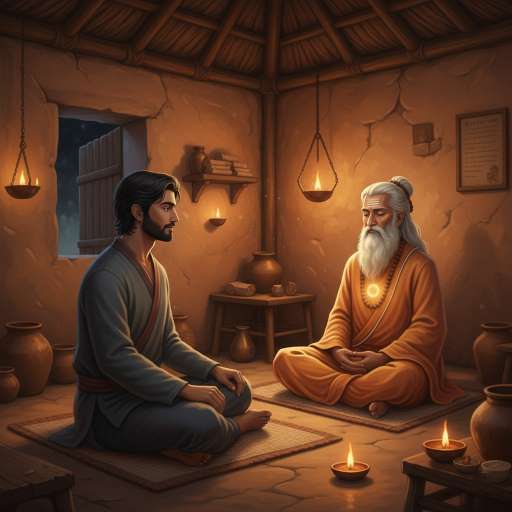
Meditation in the Hut:
He motioned for Arjun to follow a narrow path deeper into the woods. They walked until they reached an old hut where Devanta often meditated. Inside, candles flickered and cast warm circles of light on the clay walls.
The sage asked Arjun to sit. “Close your eyes.”
Arjun hesitated but obeyed.
“Think of your grandfather,” Devanta said gently. “Not his body, but his essence—his laugh, his kindness, his strength.”
Arjun’s chest tightened. He saw his grandfather teaching him how to fish, waking him for morning prayers, and telling him stories by lantern light.
“Now notice,” Devanta continued, “those memories are alive in you. His wisdom still guides your choices. His love breathes through your decisions. Tell me… has he vanished?”
Arjun felt warmth spread through him. The memories were vivid and real—more real than the ashes on the hill.
“No,” Arjun whispered. “He hasn’t.”
Devanta nodded. “The soul wears bodies the way we wear clothes. When one garment becomes old, it is set aside. But the wearer remains.”
Arjun opened his eyes slowly. “So the soul continues… even after death?”
“Beyond death,” Devanta said, “beyond birth, beyond fear. That is why the Gita says the soul is unborn, eternal, everlasting, and primeval. It cannot be cut, burned, wet, or dried. It simply is.”
The truth began to settle inside Arjun—not as a philosophy, but as a quiet certainty.
“But why don’t we remember our past lives if the soul is eternal?” he asked.
Devanta smiled. “Do you remember every dream you had as a child? Does forgetting make the dream any less real? The soul carries impressions, lessons, and energies from life to life. The mind forgets; the soul never does.”
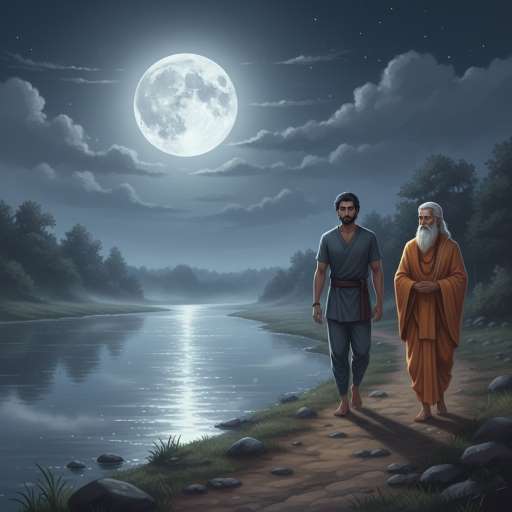
Moonlit River Walk:
Arjun breathed deeply. For the first time since the funeral, the tightness in his chest began to loosen.
They stepped outside the hut. The moon had risen, silver and serene. The river shimmered like a path of light leading into the unknown.
“Come,” Devanta said. “Let us walk back.”
As they made their way toward the village, Arjun noticed something new in the night air—a softness, a silent reassurance. The world felt different, as though a veil had lifted.
When they reached the hill, Arjun paused near the still-glowing embers of the pyre. The smoke curled upward like a final blessing.
He closed his eyes and whispered, “You’re not gone. I understand now.”
Devanta placed a hand on his shoulder. “Grief will visit you again. That is natural. But let it pass through you. Do not hold it hostage in your heart. The soul does not linger in ashes; it moves forward.”
Arjun nodded. For the first time, he believed it.
As dawn approached, a soft golden light spread across the horizon. The world awakened, and the river shimmered once more. Arjun watched it flow with renewed eyes.
“Life continues,” he murmured.
Devanta smiled. “Yes. And so do we.”
The sun rose fully, painting the sky with hope. Arjun felt his grandfather’s presence—not as a memory, but as a quiet strength inside him.
Then, with clarity he had never known before, he whispered the verse to himself:
“The soul is never born, nor does it ever die.”
And for the first time in his life, the words felt true.
Moral of the story:
Through Arjun’s journey of grief and guidance from Sage Devanta, the story shows that while the body dies, the soul remains eternal. Loss and sorrow are natural, but understanding the soul’s timeless nature helps us transform grief into peace. Memories, love, and wisdom of those who have passed continue to live within us, guiding our actions and shaping our lives.
In essence: True connection and presence are not limited to the physical form; the soul’s essence endures beyond life and death.
To explore more on stories and dive into related ideas, be sure to check out the other posts where we cover all sort of stories related to quotes. Stay tuned for more…..
To explore more on quote topics, be sure to check out the other topics where we cover all categories of quotes. Stay tuned for more…..